7 August 2026Jorge Alves
Bespoke, custom, made to order: what the words actually mean
Bespoke, custom and made to order are three different things. What separates them, what each costs in time and latitude, and how to tell which you are buying.
Bespoke. Custom. Made to order. The three phrases turn up on the same product page, in the same brochure, sometimes in the same sentence — and they describe three genuinely different things. The blur is convenient for whoever is selling and expensive for whoever is buying, because the distinction decides how long you wait, how much of the piece you actually control, and what can be done if the thing that arrives is not the thing you pictured.
We build furniture to order, so we have a position in this. What we can usefully offer is precision about where the lines fall, including where they fall against us.
What the three words describe
Bespoke: drawn from nothing, for one room
A bespoke piece does not exist before it is commissioned. It begins as a drawing made for a particular room, a particular use, sometimes a particular wall. Proportions, joinery, the profile of an arm, the fall of a seat — all of it is resolved for that one job, and then somebody builds it, usually for the first time. The consequences follow: a longer program, drawings to approve, occasionally a prototype, and a price set per project rather than per product, because nobody has built the thing before and there is no experience to quote from.
Custom: a standard piece, altered within defined limits
Custom starts from something that already exists in a catalogue and changes part of it. The manufacturer publishes what may be changed: this range of fabrics, these three wood tones, that leg instead of this one. Everything outside the list is fixed, because the patterns, the tooling and the line are built around the standard version.
In practice, custom very often resolves to one thing — a fabric swap on a fixed frame. That is a real service and for plenty of projects it is exactly enough. It is simply not the same as having a piece made to your specification, and it should not be priced as though it were.
Made to order: an existing design, built only once you buy it
Made to order describes when a piece is built, not how much of it you can change. Nothing sits in a warehouse waiting to ship; the frame is cut after the order is placed. The design itself already exists — it was drawn and resolved by the maker before you arrived.
This is where the range is widest, and where buyers most often assume something untrue. Some made-to-order houses will change only the covering. Others will move dimensions, change the wood, specify a different stone and a different metal, and build to a width that suits the wall you have. Both are accurately described as made to order. Only one of them gives you a piece that answers to your room.
Inside the industry none of this is obscure. The terms drift because bespoke carries the most weight, so it gets attached to work that is catalogue production with three fabric options — and because nobody is obliged to define it. There is no standard, no certification, no regulator. The word is free to use.
What changes for the buyer
Four things move with the distinction, and only one of them is price.
Time. Stock ships in days because it was built before you existed as a customer. Made to order runs in weeks or months, because it is built after. Bespoke adds the drawing and approval stage on top of that, and a first-off piece often reveals something that has to be redone. If a supplier quotes a bespoke program in the same breath as a stock lead time, one of the two is not what it says it is.
Cost. Custom is usually a base price with surcharges — the piece plus the upgrade. Made to order is priced per design and per specification, so a change of stone or a wider frame moves the number rather than adding a line to it. Bespoke is priced per project, because there is nothing to compare it against. The useful question is never what it costs but what the price includes, and where it stops holding.
Latitude. This is the real test, and it is easy to run. Ask for something that is not on the options page — a seat five centimeters lower, a sofa built to 2.4 meters rather than 2.2. If the answer is a list, you are buying custom. If the answer is a question about your room, you are somewhere else.
Recourse. Worth settling before you sign. With stock, a fault is a replacement from the warehouse. With anything built once, for you, there is no shelf to draw from — the remedy is remaking, which means waiting again. That is why the approval stage matters more than the guarantee: physical samples in the light of the actual room, dimensions confirmed in writing, drawings signed off before anything is cut. Any maker worth the commission would rather argue about a sample than a finished sofa.
Where Elbra sits, and why
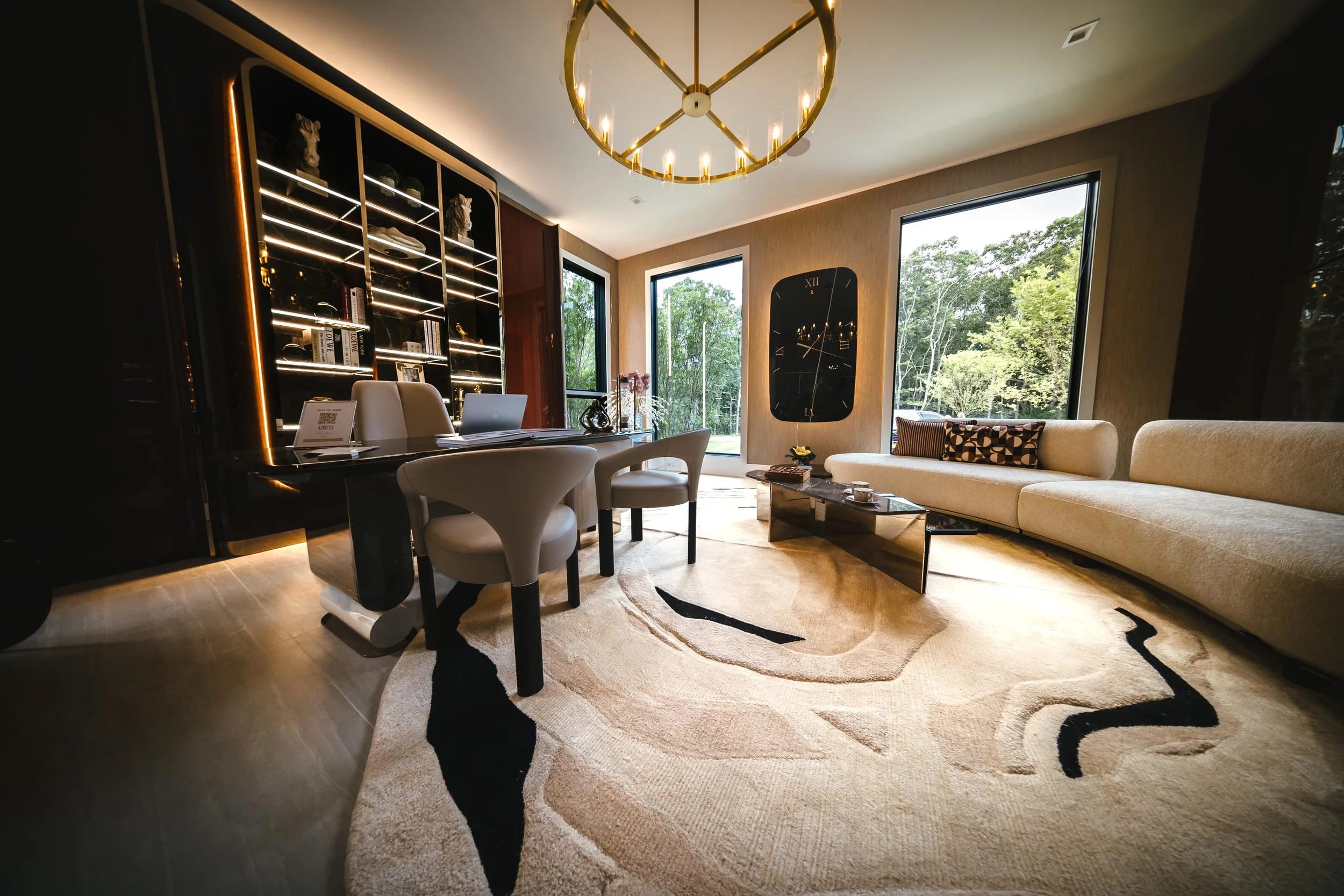
Our pieces are designed in-house and built only once ordered. The design already exists — drawn, proportioned and resolved before you see it — and then the fabric, the wood, the stone, the metal finish and the dimensions are specified by the client. That is made to order at the wide end of the range, and it is deliberately neither of the other two things: not a catalogue with a fabric list attached, and not fitted carpentry drawn from scratch for a single alcove.
The part that is unusual is being able to see the specification before committing to it. Many of our pieces carry a 3D configurator that renders the actual combination — this wood with this stone, that metal against that cloth — rather than asking you to assemble it in your head from swatches on a screen. It answers the question a sample card cannot: not whether each element works, but whether they work together.
It does not replace the samples. Stone reads differently slab to slab and cloth differently dye lot to dye lot, so the final finishes are always confirmed in hand, against the light of the room they are going into. The configurator narrows five plausible schemes to the one worth sampling. That is its whole job.
Why the wait is ten to twelve weeks
Made to order has one cost that no amount of good service removes: you wait. Our lead time is ten to twelve weeks. If a project completes in three weeks, made to order is the wrong purchase and no one is served by pretending otherwise.
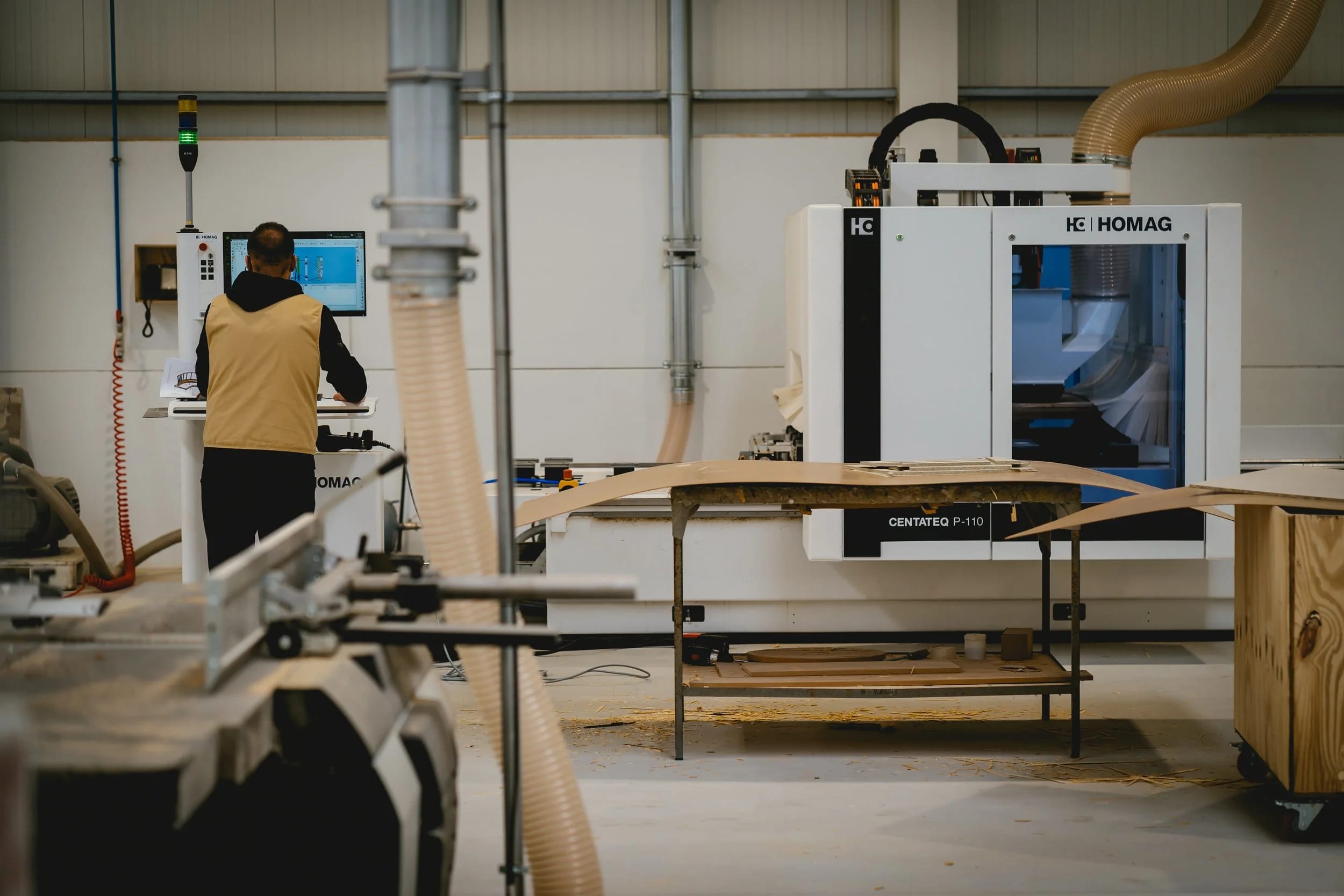
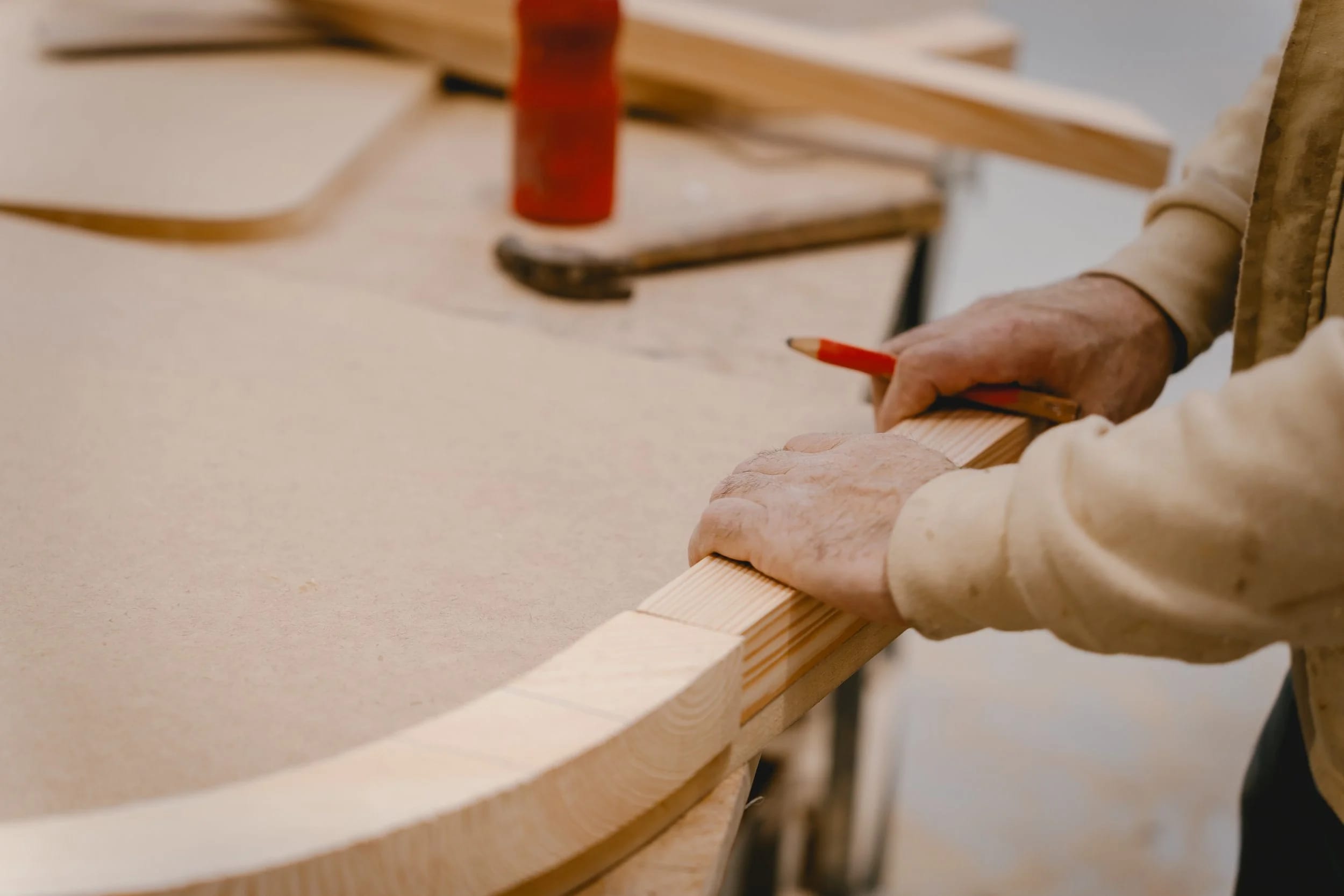
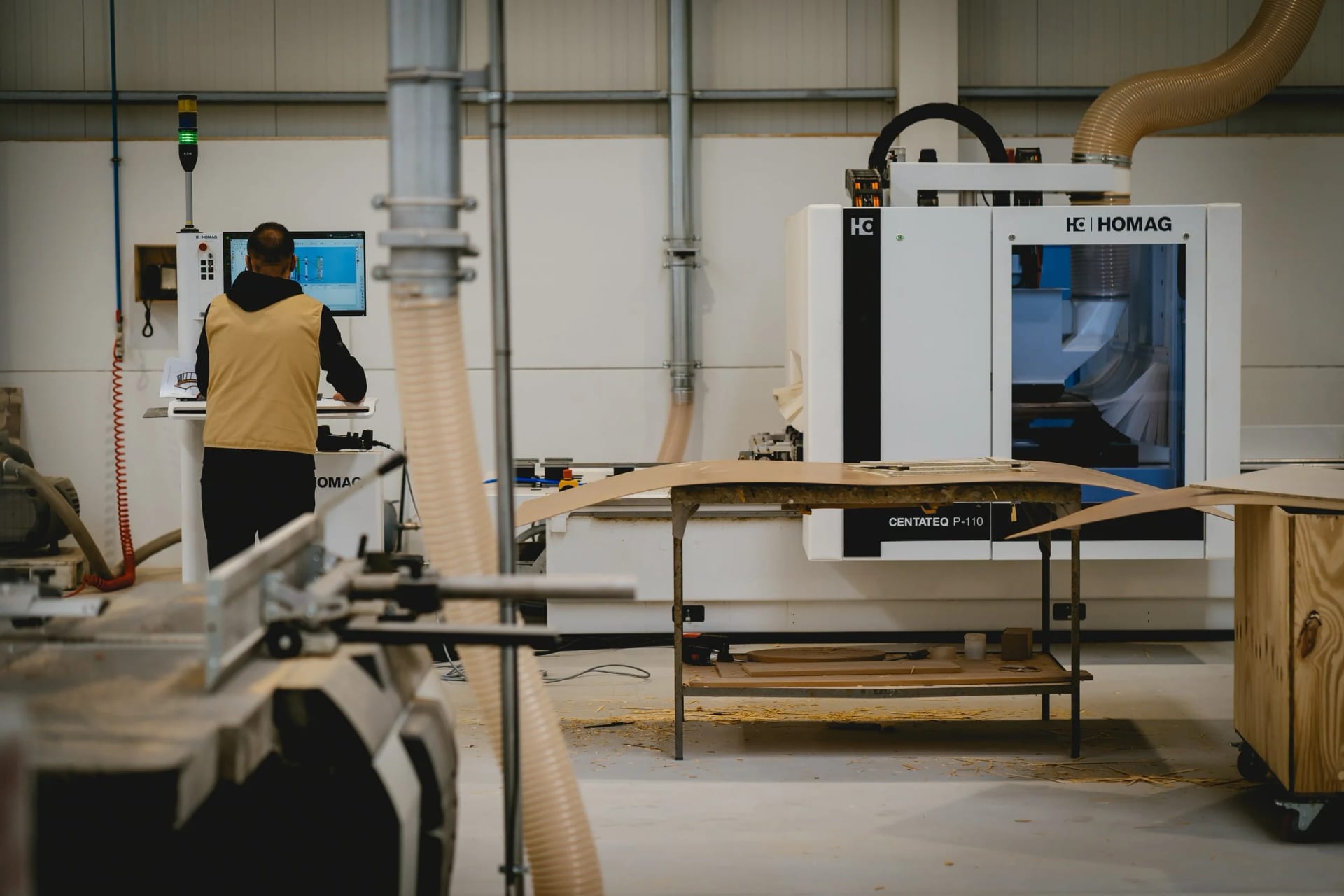
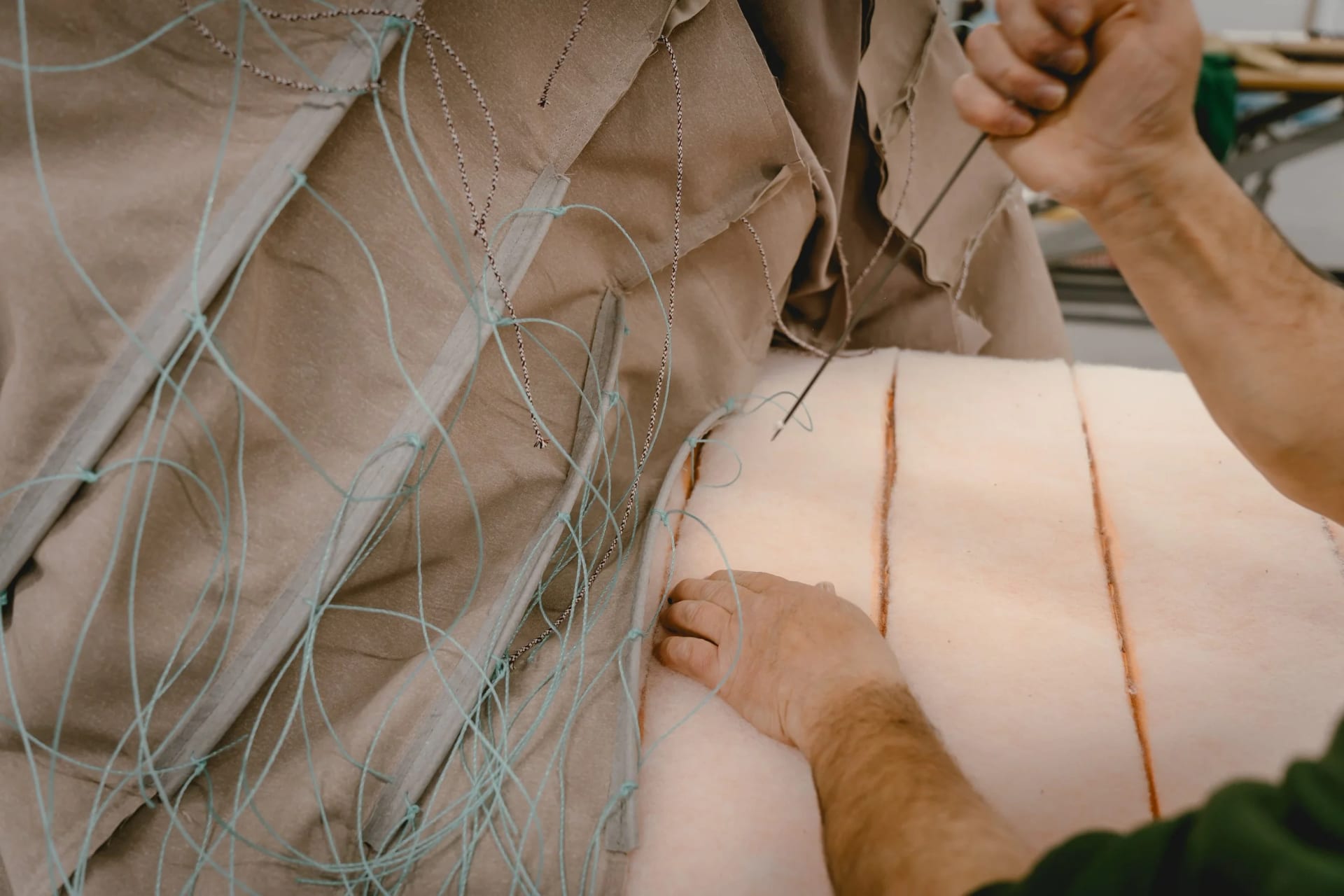
The time is not queueing. Our atelier is in Carvalhosa, Freamunde, in Paços de Ferreira — the area of northern Portugal long known as the Capital do Móvel, with a manufacturing base deep enough that a great many international brands have their furniture built here. What happens there is a mix. Panels are cut on CNC machinery, because a machine cuts a repeated panel more accurately than a person and there is no virtue in pretending otherwise. Then the work slows down. Frames are marked out at the bench with a pencil. They are sanded by hand, in stages. Seats are sprung and tied by hand, twine over hessian, the way upholstery has been built for a very long time because nothing faster holds its shape as well.
Added to that: stone is selected slab by slab, cloth is ordered per commission rather than pulled from a rack, and lacquer and finish need time to cure that cannot be compressed. Ten to twelve weeks is what those steps take when nobody is asked to hurry.
What to ask before you commit
Five questions will place any supplier in one of the three categories, usually within a minute.
- Is this design yours, or is it being drawn for me? That single answer separates bespoke from the other two.
- What can change that is not on the options list — specifically, can the dimensions change? Dimensions are the honest test. Fabric choice is cheap to offer; a different width means recutting a frame.
- What am I approving before anything is cut, and in what form? Physical samples, a dimensioned drawing, a photograph of the actual slab. Anything approved on a screen alone is not approved.
- When does the clock start, and what starts it? Lead times are quoted from deposit, from sample sign-off or from order confirmation, and the gap between those dates can be weeks.
- Who makes it, and where? Ask plainly. A maker who owns the bench will tell you the town. A brand that subcontracts will tell you the continent.
The vocabulary matters because all three models are legitimate, and the wrong one for your project only shows up at delivery — a beautiful piece thirty centimeters too wide for the wall, or a twelve-week wait for something you could have had in two. Knowing which of the three you are buying is the difference between choosing furniture and being surprised by it.
If you are specifying for a project rather than a room, the trade program covers the parts of this that only matter at scale; if you would rather see the bench than read about it, the atelier receives visits by appointment.