7 August 2026Jorge Alves
Portugal's furniture country: why the region matters more than the label
Portugal's furniture region packs its workshops into a few kilometers. What that density actually buys the person commissioning a piece.
The label under a sofa tells you where it was assembled. It does not tell you who tied the springs, whether the frame was drawn at full size before anything was cut, or how far the finishing shop stood from the bench where that frame was built. Those things decide how a piece looks in its tenth year, and most of them are settled by geography long before a client sees a drawing.
Our atelier is in Carvalhosa, on the Freamunde side of Paços de Ferreira, in the north of Portugal. Furniture is made in this area at a density that has no real equivalent elsewhere in the country, and the explanation has less to do with heritage than with distance.
A furniture region, not a single factory
Paços de Ferreira and the municipalities around it are known as the Capital do Móvel — Portugal's furniture capital. The phrase does not describe one large plant. It describes a density of small and mid-sized businesses each doing something narrow, and doing it constantly: frame makers, veneer and board suppliers, timber merchants, foam and fiber houses, spray and lacquer shops, upholsterers, metalworkers, glass cutters, stone yards, hardware factors, and the vans that spend the day carrying parts between all of them. Drive ten minutes in any direction and you pass a dozen of them behind unmarked gates.
Portugal supplies furniture to brands that sell it under their own names in other countries, and a good deal of that work passes through workshops of exactly this kind — which is why the origin of a piece is usually quieter than its label. The region can quote a piece, prototype it, finish it and crate it without the work ever leaving a small radius. For us that is not a business model, it is simply where we are: our suppliers are our neighbors, and a supplier who is also a neighbor behaves differently.
What proximity buys: a correction made in a morning
A prototype armchair comes off the bench. Someone sits in it. The back is a degree or two too upright, the arm reads heavy from the doorway, and the seat is deeper than the drawing led anyone to expect. In a dispersed supply chain each of those is an email, a revised drawing, a shipping note and a wait. Here the frame maker is a few minutes away, the foam supplier a few minutes further, and the finishing shop is on the way back. The angle is recut, the arm re-shaped, and a fresh finish sample sprayed and dry before the end of the day.
The point is not speed for its own sake. It is that the cost of changing your mind stays low, so more changes actually get made, and the piece that finally ships has been argued with more times than it otherwise would have been. When we say a piece is made to order in ten to twelve weeks, with fabric, wood, stone, metal finish and dimensions all open, that promise rests on this geography. A workshop that has to send a frame four hundred kilometers to be sprayed cannot sensibly offer it.
It also decides what the material palette can be. When a stone yard and a lacquer shop are both within reach, an unusual marble, or a color matched to a client's own sample, is a conversation rather than a special order with a minimum quantity attached.
The knowledge that is passed on at the bench
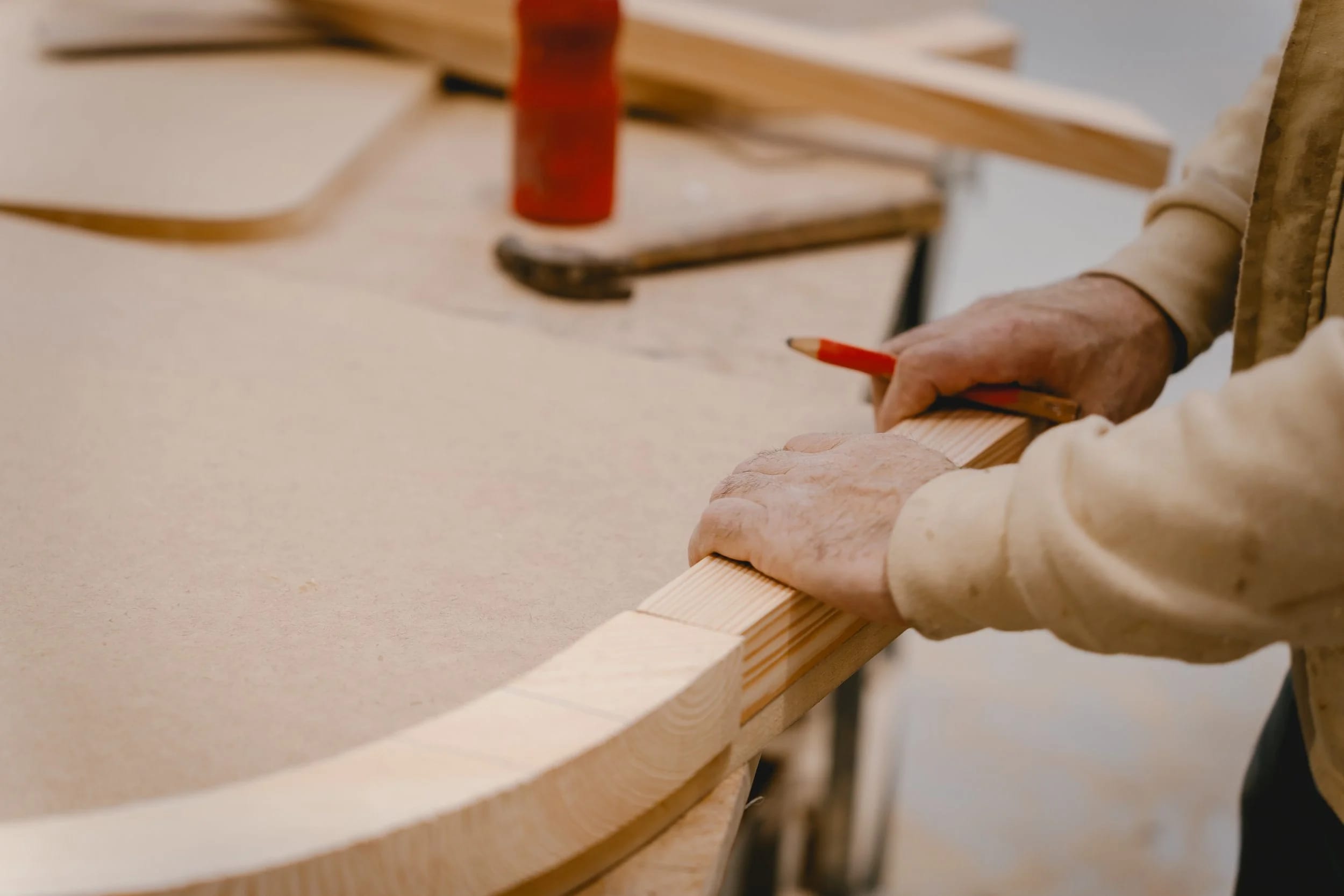
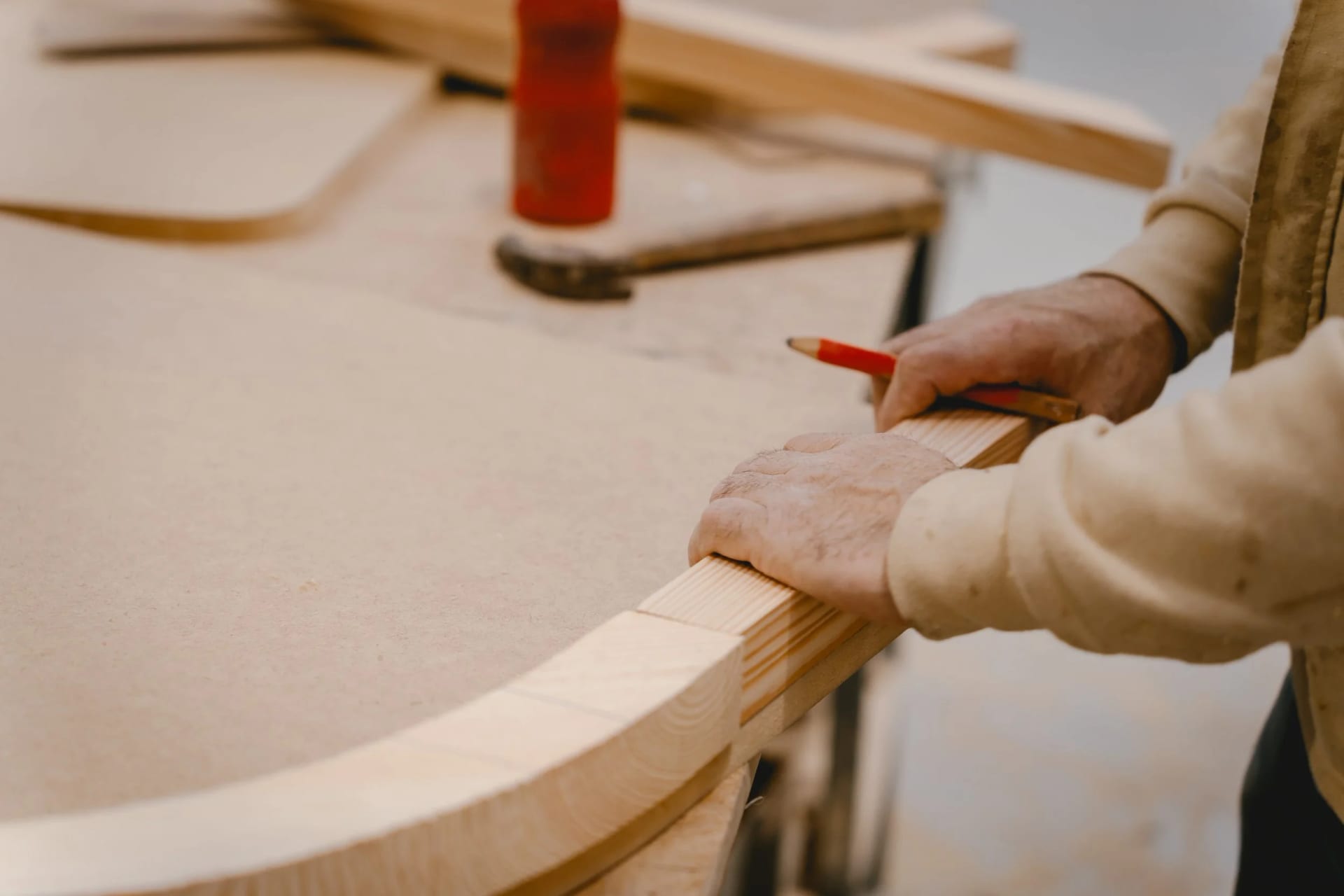
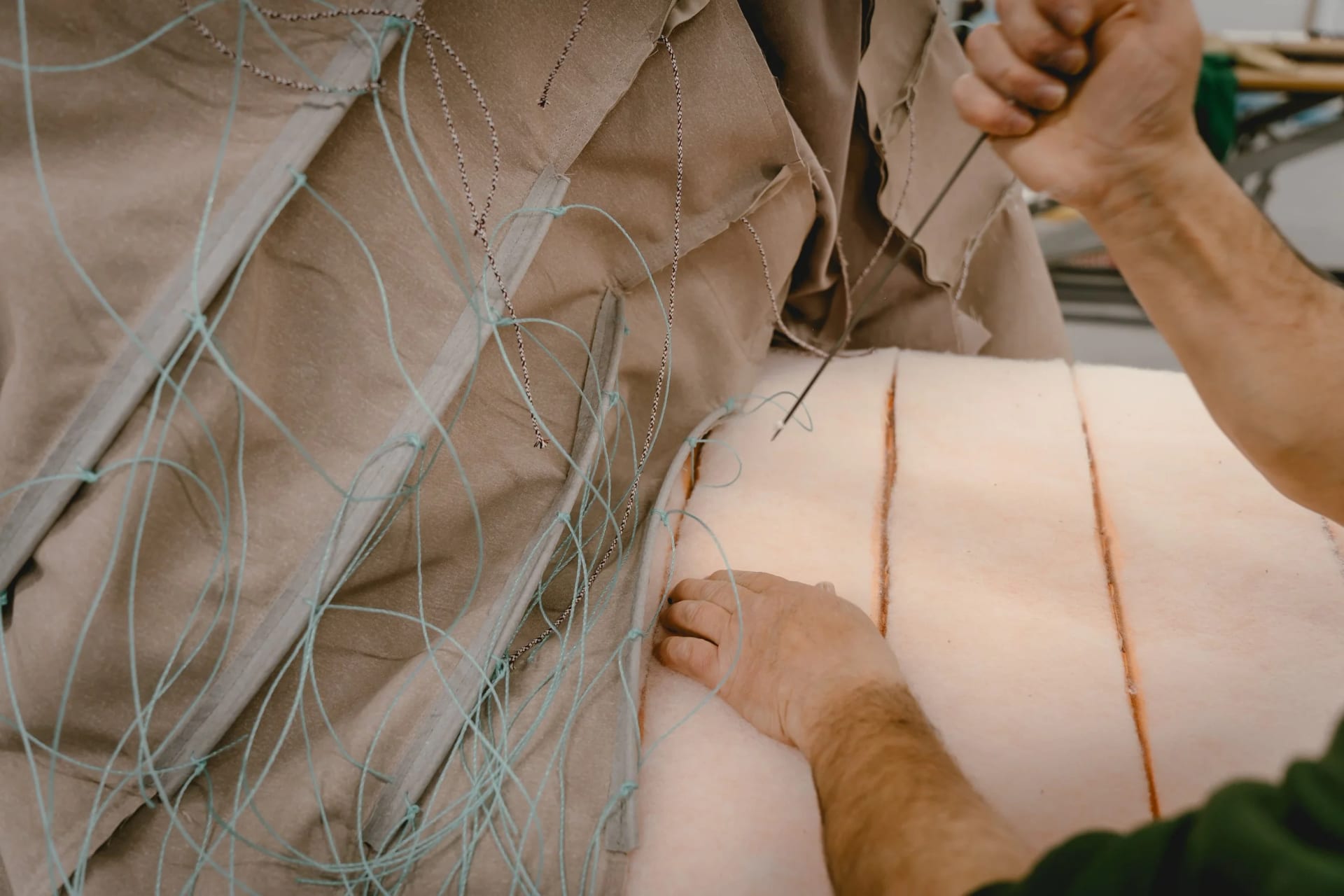
The second thing a region like this produces is people. Marking out a curve so that it stays fair the whole way around a frame. Reading a board before cutting it. Judging by hand, not by eye, when a surface has been sanded enough and when another pass will start to soften an edge that should stay crisp. Tying a sprung seat so that it is still even after a decade of being sat in. None of that is learned from a manual. It is learned standing beside someone who has done it several thousand times, and being corrected.
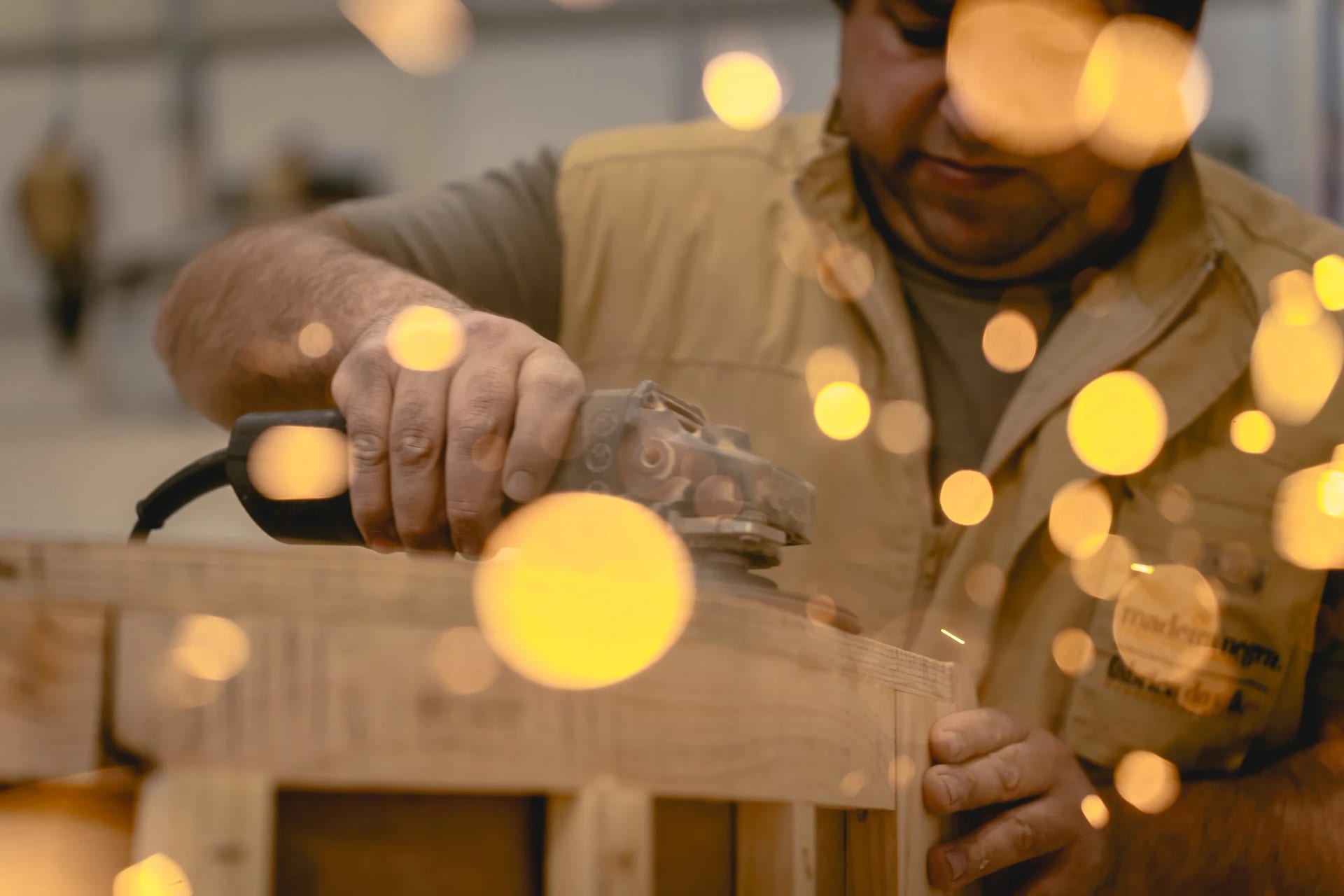
Where workshops are dense, that transfer happens as a matter of course. A cabinetmaker who leaves one bench finds another a few kilometers away, so the skill stays in the area instead of dispersing into other trades. An upholsterer here has usually seen more seats than one working where furniture is one industry among many. This is not romance about craft; it is a labor market, and it is the reason a hand-tied seat is still an ordinary thing to ask for rather than a revival.
Machines for repetition, hands for judgment
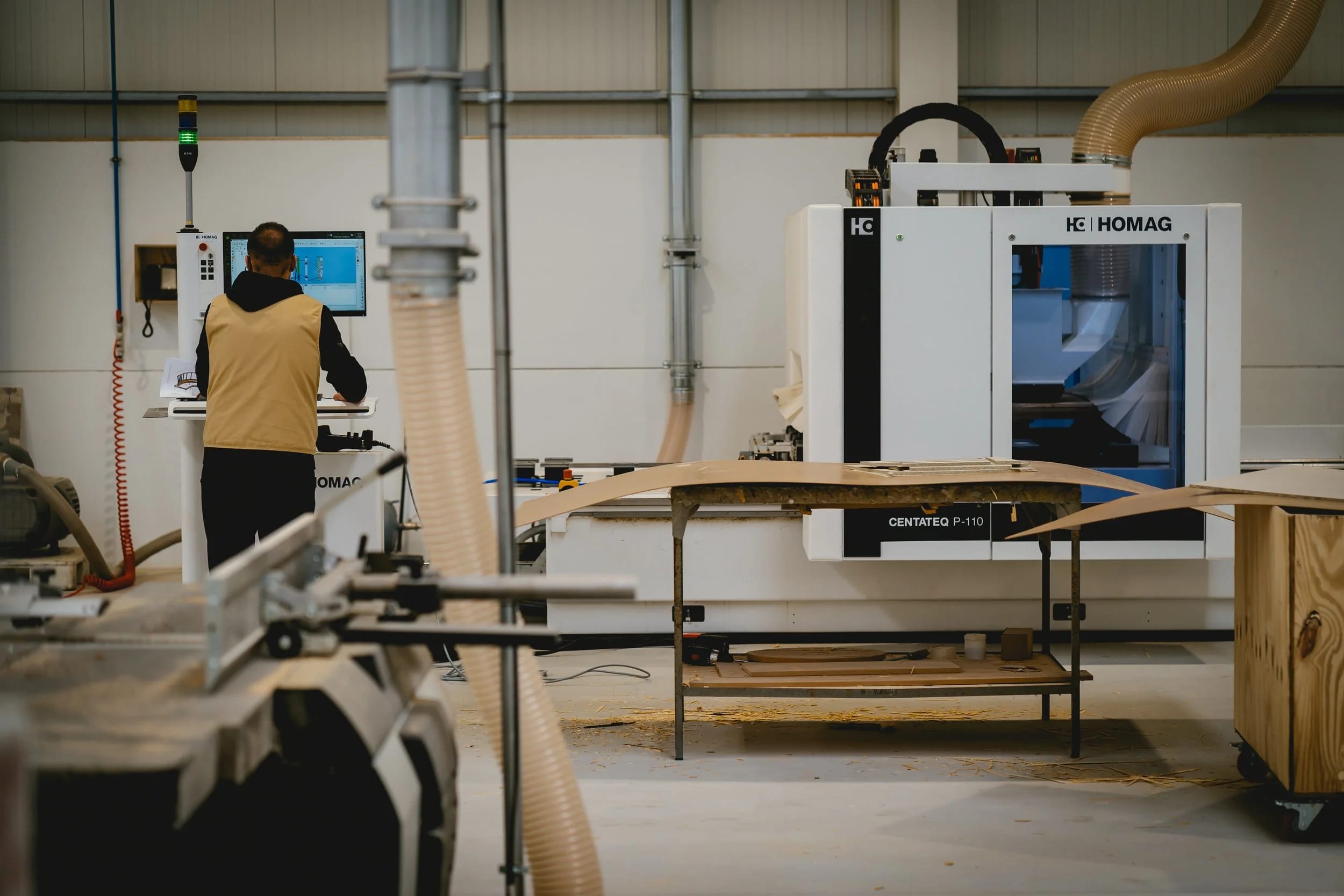
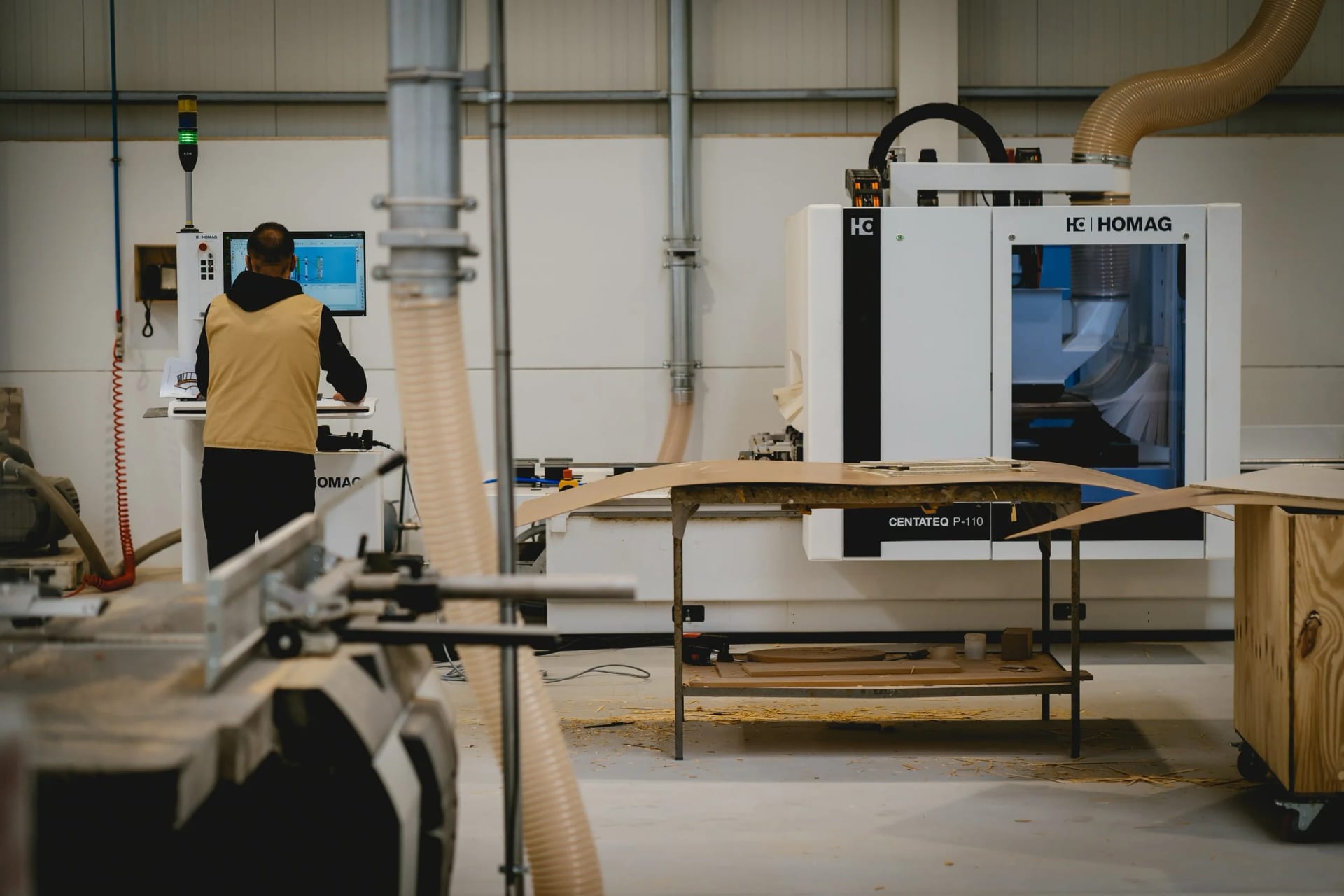
It would be dishonest to describe these workshops as quiet sheds full of chisels. Ours has a CNC machining center with a control screen and extraction ducting overhead, panel saws worked off a monitor, and stacks of cut panels and veneer waiting on trestles. The machining center and the pencil on the curved frame are under the same roof.
The interesting question is not machine or hand. It is which one does what. Machines are better than people at anything that has to be identical: six curved backs that match across a run, joints cut to the same tolerance at the end of a batch as at the start, a sequence of holes that lets a large piece be knocked down for shipping and reassembled true on the other side. They are patient, and they are as accurate at four in the afternoon as at nine in the morning.
What they cannot do is judge. A machine cannot feel that a board is about to move, or ease an edge so that a hand passing over it finds nothing to catch on, or decide that a curve which is geometrically correct still reads heavy in the room. It cannot sand across a joint by feel, set the tension in a sprung seat, or lay a hide so the grain runs consistently across a back. Where a part is repeated, the machine does it, and does it better than we would. Where a part requires a decision, a person makes the decision. That division is what the work of the atelier is organized around, and it is more useful to a buyer than any argument about tradition.
What "made in Portugal" does not guarantee
It tells you where a piece was assembled. On its own it says nothing about how. These are the questions worth asking here, of us or of anyone else.
- What is inside the frame. Kiln-dried hardwood, properly jointed, or stapled softwood and sheet material. Both leave this region every week.
- How the seat is suspended. Hand-tied springs, serpentine springs, webbing, or a foam block on a platform. Each is a legitimate choice at a different price and a different lifespan, and the answer should come without hesitation.
- Where the finishing happens. Color matching, and any later repair, are far easier when the sprayer and the cabinetmaker answer to the same person.
- How much can genuinely change. "Customizable" sometimes means a choice of four covers. Ask whether dimensions can move, at what point in the process a change stops being free, and whether the workshop will work to a fabric you supply.
- Whether you can see it. A workshop that receives visitors has usually thought about what visitors will find.
Those five questions separate a piece made to order from a stocked piece with options, and they do it faster than any origin label. If you specify professionally, our trade program answers them in writing; the shorter version is in the questions we are asked most.
The region will go on supplying names other than its own, and there is nothing wrong with that. But the case for making here was never the label. It is that a difficult piece can be corrected on a Tuesday morning by three people who can walk to each other — which is worth seeing, if you ever arrange to come to the atelier.